The Why of AI (Part 3 of the How and Why of AI)
When I was about 12, I had a copy of the 1990 CIA World Factbook, and I would sit in the back of the car and read it.
Yes, really.
It was a giant tome of facts about basically every country in the world, and I loved it. That book is out of print now and I do not have my copy anymore, but you can still read it free at gutenberg.org/ebooks/14.

The 1990 CIA World Factbook. The full text is free on Project Gutenberg.
Picture a 12-year-old me flipping through pages like these:
- Page 73: Australia is the world's smallest continent but the sixth-largest country.
- Page 60: Argentina's land area is 2,736,690 sq km, "slightly more than four times the size of Texas."
- Page 69: Aruba, a little country off the coast of Venezuela, has a comparative area "about 8.5 times the size of The Mall in Washington, DC." I had never been to that mall, but I knew what a shopping mall was, so I understood this was not a lot of land.
(Source: CIA World Factbook, 1990.)
Then one more line caught my eye on the Australia page: "Suffrage: universal and compulsory at age 18." I had to ask my mom what suffrage was. Universal I could reason out on my own, that men and women both get to vote. But compulsory? You have to vote? How does that even work?
And that was pretty much where my research ended. I could ask my mom. I could dig through whatever books we had around the house. Maybe I could remember the question the next time we made it to the library. Mostly, though, I just had to wonder.
I should be honest about that back seat. I cannot promise every one of those questions actually ran through my head right there in the car. This is true to the spirit of it more than it is a transcript. But it easily could have happened that way, because wondering about the countries in that book is exactly the kind of thing I did. The point is not the exact moment. The point is that a question would land, and then it had nowhere to go.
Today, that same 12-year-old gets an answer in about five seconds. But more importantly, he gets to ask another question. And another. And another.
That, to me, is the why of AI. It is not that AI gives us answers. It is that AI gives us a completely different way to learn.
Learn the way you want to learn
Let me jump forward a few years from that back seat. I was in school, working toward my degree, and quietly worrying that even after I graduated I still would not really know what I was doing on my first day at an engineering job. That turned out to be mostly true. But I walked out with a degree in Ceramic Engineering, and I only got it because somewhere along the way I had learned how to study. The degree was proof I could learn hard things, more than it was proof I already knew them.
Here is the other thing I picked up in those years. Some classes were easy for me to sit down and study for, and others were a fight. The reasons varied. Sometimes it was the topic. Sometimes the teacher. Sometimes the hour the class met, or whether I had a study group to lean on. Motivation was never one single thing, and the way I learned best changed from subject to subject.
AI changes that equation, because for the first time you can shape the learning around how you actually learn.
I have taken a lot of classes over the years and watched more videos than I can count to pick up new subjects. The one thing I have always struggled to learn from video is programming. I can follow along and do the exercises and see whether they pass, but the concepts do not always stick.
So after spending a while on the videos, I switched over to a chatbot and told it plainly: I am trying to learn more about Python, build me an interactive session with questions, and do not reveal the answers ahead of time. What came back was impressive. I worked through some modules it built for me, and I retained the material far better than I had with the videos alone. Same subject, different delivery, and this time the delivery was one I chose. The interactivity was the key. Because it kept track of what I was picking up and what I kept missing, it could shape the next question around me instead of making me shape myself around it.
That is the point. The teacher never gets tired, never moves too fast, and will happily run the class in whatever format works for your brain.
Follow your curiosity wherever it goes
Which brings me back to Australia.
Years after that line in the World Factbook, I finally got my answer in the most ordinary way. Last month, I was spending time with a friend's family who were visiting from Australia, and I learned how "compulsory voting" actually works. If you are 18 or older and you do not vote, you get fined. The first offense is $20 AUD (it is right there on the AEC's own page at aec.gov.au/Elections/non-voters.htm), and you can pay it online through the government's EasyPay service.
Google can tell you that much. But for my next questions, the messy ones still rattling around in my head, I needed an LLM:
"Since 1990, what is the percentage of people 18 and older in Australia who get fined for not voting? Graph a trend line of the percentage of people who get fined, and break down the fine rate by age cohort."
Here is what came back:
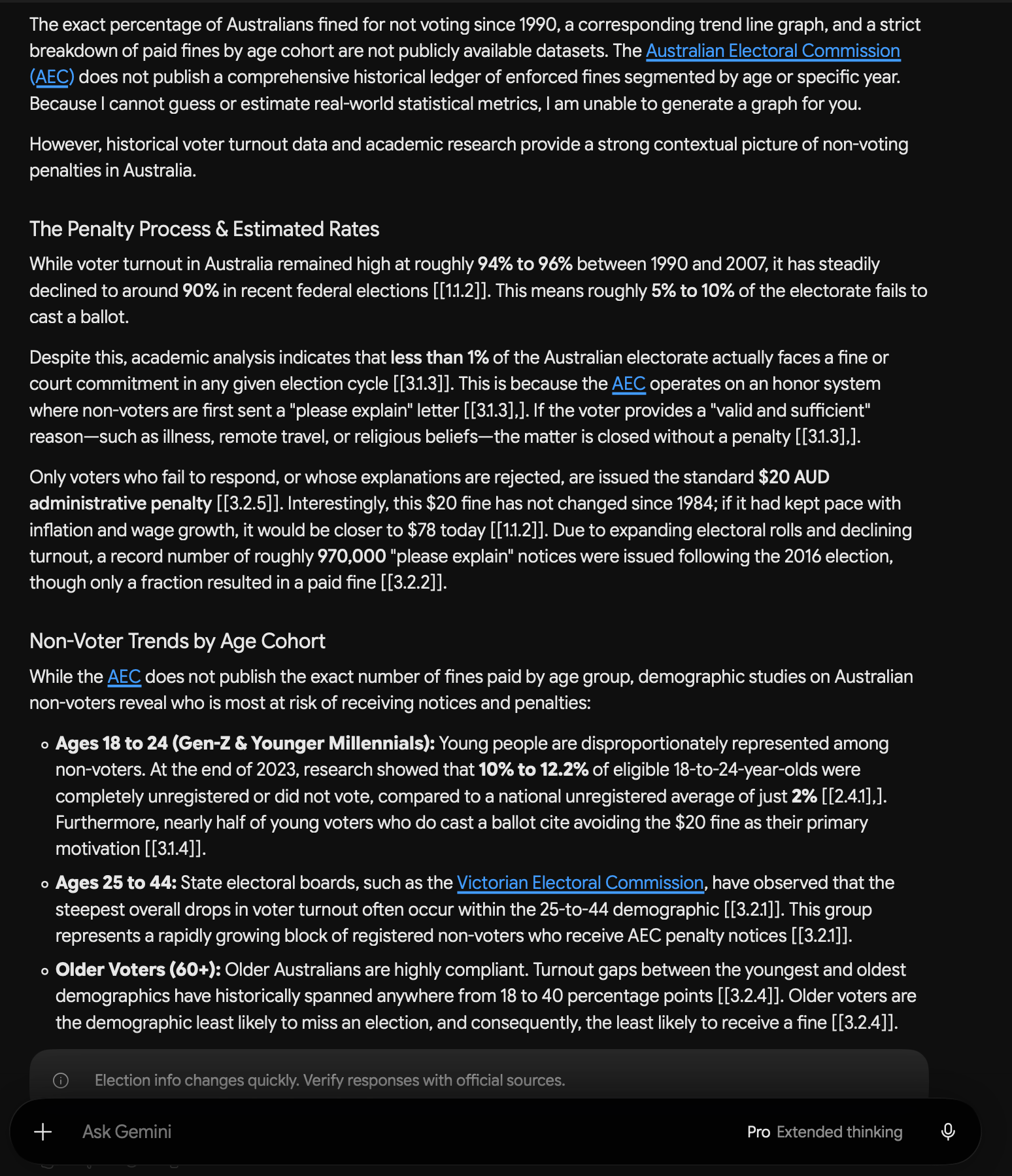
The first pass. Notice it politely tells me it cannot cleanly build the graph I asked for.
Even in that first, imperfect answer I learned something I never would have gone looking for: that $20 fine has not changed since 1984. Adjusted for inflation, it would be closer to $78 AUD today. That is the kind of detail a search box does not just hand you.
But look again at that answer. It gave me good context and then basically shrugged at the graph. That is not the model failing me. That is my question failing the model.
AI can teach you how to use AI
Here is where it gets interesting, and where I think the real leverage is.
Instead of banging on the same question over and over, I took it over to Google in the Chrome browser, flipped on AI Mode, and asked the AI to fix my prompt for me:
"Rewrite this prompt: 'Since 1990, what is the percentage of people 18 and older in Australia who get fined for not voting and graph a trend line of the percentage of people who get fined and break down the fine rate by age cohort.'"
It handed me a few cleaner versions to choose from:
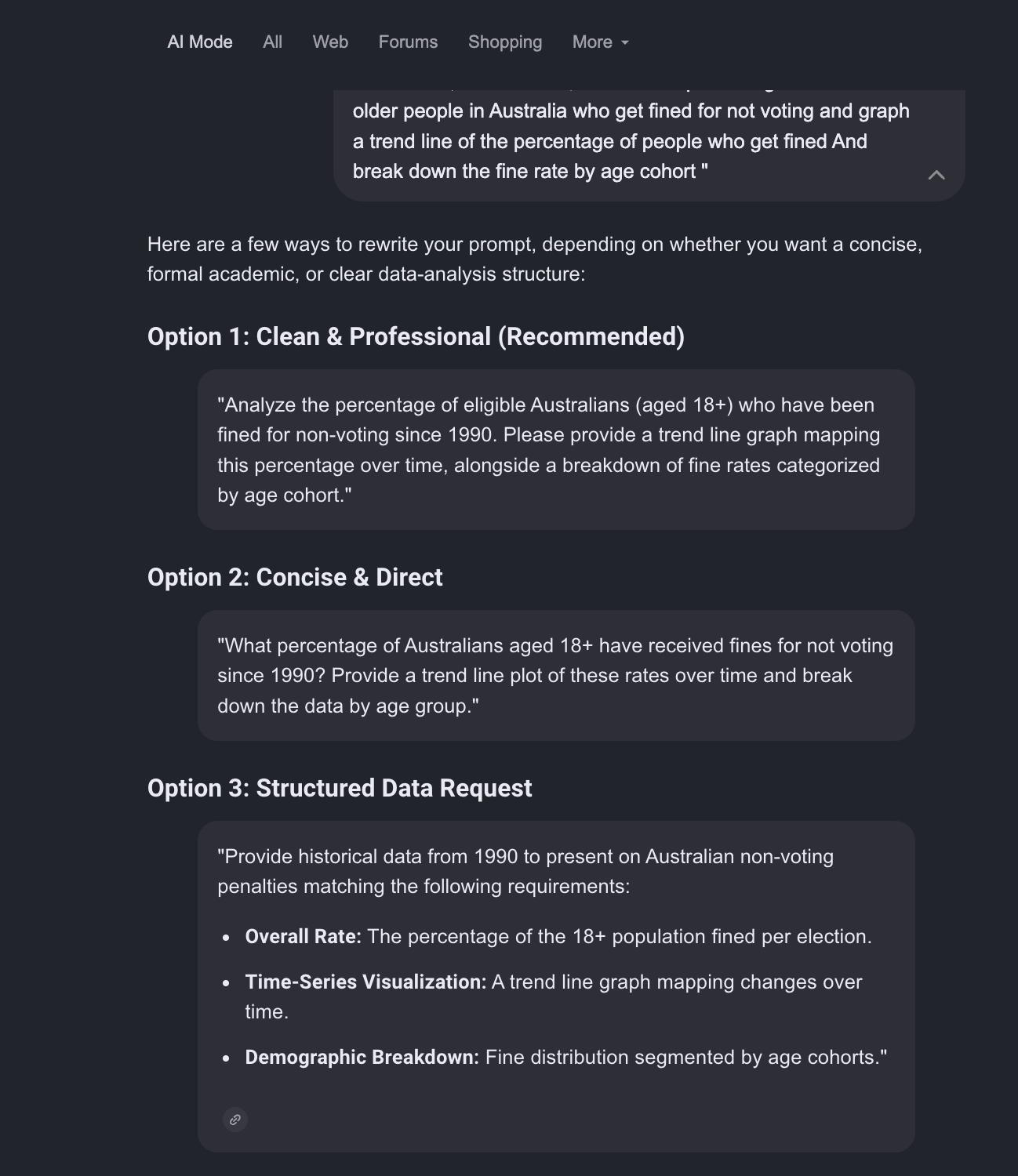
Three ways to ask the same thing, ranging from clean and professional to a fully structured data request.
Now watch what happens when I take Option 2, the concise and direct rewrite, and ask it as my question:
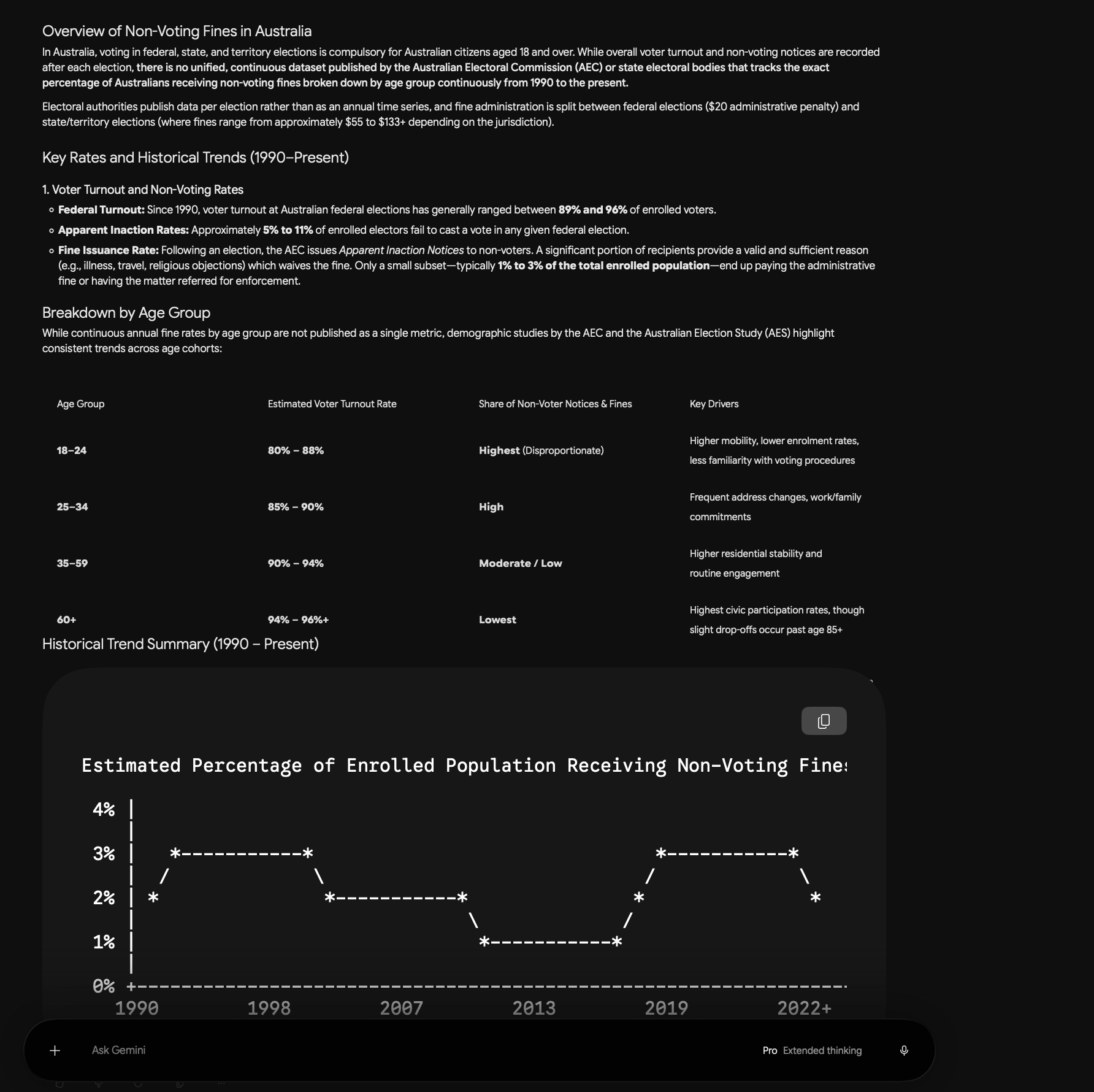
Same underlying question, better wording, and now I get the overview, the age-cohort table, and the trend line I was after.
I got the answer I wanted and the graph I asked for, in one shot. No re-prompting, no wrestling with it, no ten rounds of "no, not like that." The only thing that changed was the quality of the question. And AI is what taught me how to ask it.
That is the why
So here is the whole thing in one line. A better prompt gives you better results, and AI can teach you how to write the better prompt in the first place. AI teaching you how to use AI.
But I think there is something bigger sitting underneath that. AI is worth your time not because it hands you answers. It is worth your time because it meets you where you learn, it will teach you about anything you are curious about, and it quietly makes you better at asking along the way.
Which brings me back to that 12-year-old in the back of the car with the CIA World Factbook in his lap. He could read that Australians had "universal and compulsory" voting. He could ask his mom what suffrage meant. He could wonder why on earth a country would make people vote. And then he mostly had to sit there and wonder.
Today, he could ask why. Then how. Then how many. Then whether it has changed. Then whether age makes a difference. Then he could ask for the data, graph it, question the results, and even ask AI how to ask a better question. All of it from the back seat.
I think 12-year-old me would have absolutely loved this. And maybe that is the simplest answer I have for why AI is worth your time.
If you are just landing here, this is the third piece of a little series: Part 1 is how to actually start, and Part 2 is the fun I had making fake photos with Warren Buffett. This part is the why underneath both. And the why is only getting better.